






Introduction to Balancing Valves for HVAC Systems
Author:bohansi Time:2026-07-31 14:19:31 Click:114
Walk onto any commercial chiller plant and the symptoms of poor hydronic balance are easy to spot: some zones never reach setpoint, others overcool and waste energy, and the pumps run harder than the design called for. In our commissioning work, the root cause is rarely the chiller. It is almost always unbalanced flow. The balancing valve is the tool that puts every circuit on its designed flow, and understanding it is the first step toward a plant that actually performs as modeled.
What a Balancing Valve Does in a Hydronic Loop
A balancing valve is a calibrated throttling device that sets a fixed resistance in a pipe so a precise flow passes to each branch. Unlike a control valve that modulates with demand, a balancing valve is set once during commissioning and left. Its job is to force the system to follow the hydraulic design instead of letting the path of least resistance steal all the flow. Within an HVAC water loop, this means the distant fan coil and the near cooling coil receive their intended shares, so every space conditions correctly without oversizing the pump.
Static Versus Dynamic Balancing Valves
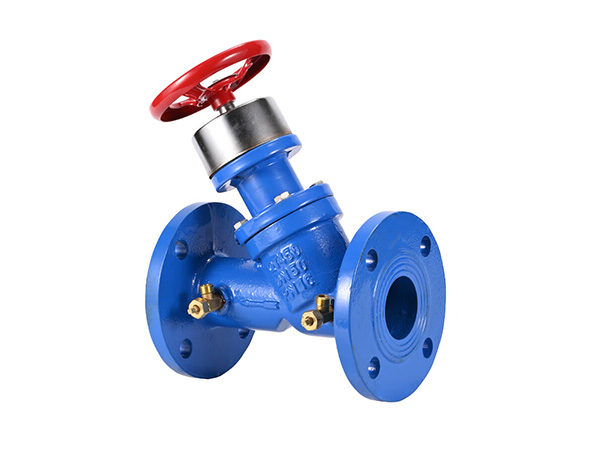
The static balancing valve is the common manual type, with a numbered handwheel and a test port that lets a technician measure flow and lock the setting. It is simple, robust, and cheap, which is why most variable-flow systems still use it on each branch. The dynamic balancing valve goes further: it contains a self-adjusting element that holds a constant flow regardless of upstream pressure changes. On systems with wide pressure swings, a dynamic device keeps design flow even when other branches open or close, at a higher first cost. A pragmatic valve manufacturer will recommend static for stable plants and dynamic where pressure fluctuation is severe.

Why Hydronic Balancing Improves Energy Efficiency
An unbalanced loop forces the designer to oversize the pump to satisfy the starved branch, and oversized pumps burn power for years. Proper hydronic balancing lets the pump be sized to true demand. Field data from retrofits we supported show pump energy dropping by double digits after balancing, because the system no longer fights itself. Balanced flow also protects coils: too much flow floods a coil and reduces heat transfer per unit, while too little starves it. The balancing valve sits at the center of that efficiency equation.
Reading the Test Ports During Commissioning
A well-made balancing valve carries a measurement tap and a published flow-versus-setting curve. The technician connects a differential pressure gauge, reads the port pressure, and uses the curve to dial the exact flow. This is where cheap imported valves fail: without a reliable curve, the setting is a guess. We train our field teams to balance from the furthest branch back toward the pump, locking each valve in sequence so earlier settings are not disturbed. A supplier that prints the curve on the tag, not buried in a manual, saves hours on site.
Material, Pressure Class, and Sizing Choices
Most HVAC balancing valve bodies are brass or bronze for small lines and ductile iron with epoxy coating for larger mains, rated to the system pressure with margin. Sizing follows the design flow and the allowable pressure drop, typically a fraction of a bar at the set position so the valve does not waste pump head. Oversizing the valve body to match the pipe is tempting but hurts control resolution, because a too-large valve sits barely cracked open. Manufacturers that offer the true sizes, not just pipe-matched bodies, give the designer a workable setpoint window.
Working with a Balancing Valve Supplier
For the specifying engineer, the valve is only as good as the support behind it. A competent supplier provides the flow curves, spare tags, and locking caps, and can deliver the full range from a quarter inch to several hundred millimeters without splitting the order across vendors. Because balancing is a commissioning task, lead time matters: a missing size during start-up stalls the whole air-handling schedule. We advise standardizing on one valve manufacturer for the balancing set so curves, test kits, and spares are consistent across the plant.
Frequently Asked Questions
Is a balancing valve the same as a control valve?
No. A balancing valve is set once for proportion; a control valve modulates continuously with the controller. They serve different purposes and are not interchangeable.
Can I balance a system without test ports?
You can throttle by feel, but without measurement you cannot verify flow. Test ports on a static balancing valve are what make the setting defensible and repeatable.
Do variable-flow plants still need balancing valves?
Yes. Even with variable-speed pumps, each branch needs a set proportion at design conditions, and a dynamic balancing valve helps hold it as pressures shift.
When should balancing be done?
During commissioning, after the system is full and air is purged, balancing from the most remote branch back toward the plant.
Conclusion
The balancing valve is a modest device with an outsized impact on comfort, energy, and equipment life. Specify the right type for the pressure regime, balance from the far branch inward using the maker's curves, and source from a supplier that keeps the full size range in stock. Done well, hydronic balancing turns a struggling loop into a plant that meets setpoint quietly and efficiently for its whole service life.
References
1. ASHRAE. "ASHRAE Handbook - HVAC Systems and Equipment." American Society of Heating, Refrigerating and Air-Conditioning Engineers, 2020.
2. CIBSE. "CIBSE Commissioning Codes: Code W, Water Distribution Systems." Chartered Institution of Building Services Engineers.
3. Wang, S., and Jin, X. "Model-based optimal control of variable-speed pumping in HVAC systems." Applied Thermal Engineering, vol. 29, pp. 654-666, 2009.
4. Underwood, C. P. "HVAC Control Systems: Modelling, Analysis and Design." Routledge, 2nd edition, 2013.
 HOT PRODUCT
 CONTACT US