






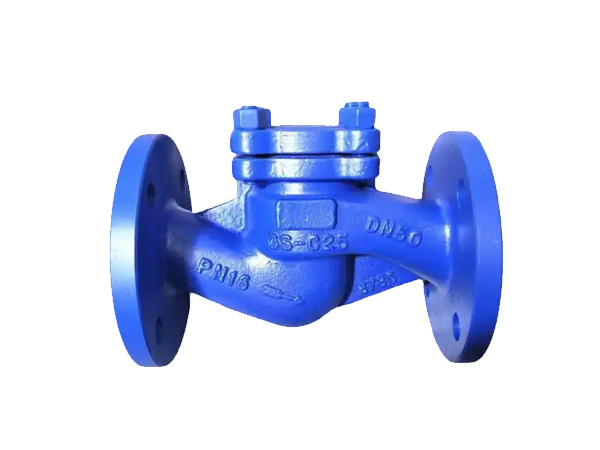
Lift Check Valve
Lift check valve is a type of automatic one-way valve that prevents medium backflow by means of vertical lifting movement of the internal plug, commonly installed on horizontal and vertical upward pipelines in industrial, water supply and chemical systems.
Its core moving component is a lift disc matched with an integral valve seat inside the valve body. When medium flows forward under pressure, fluid buoyancy pushes the disc upward to leave the sealing seat, forming a circulation channel for liquid or gas to pass through the valve smoothly. Once the upstream pump stops running or reverse pressure forms in the downstream pipeline, gravity and backflow pressure will pull the disc down tightly onto the valve seat, cutting off the reverse flow passage immediately to protect upstream pumps, pressure vessels and pipeline fittings from back pressure damage.
This valve has a straight-through internal flow passage with a vertical lifting movement track for the disc, so it has strict requirements on installation direction. Standard lift check valves are suitable for horizontal pipeline mounting, while vertical lift models are specially designed for vertical risers with upward medium flow. Improper installation will cause the disc to fail to reset, leading to permanent internal leakage.
The valve body is generally manufactured from cast iron, ductile iron, carbon steel or stainless steel to adapt to different pressure and corrosion environments. The sealing surface can be metal hard seal or rubber soft seal. Soft-sealed lift check valves realize zero leakage for clean water, oil and low-corrosion media; metal hard-sealed types withstand high temperature, high pressure and high-temperature steam, widely used in boiler and thermal power pipelines. Connection forms include flange, threaded and welded ends to match various pipeline construction standards.
Compared with swing check valves, lift check valves feature more reliable sealing performance under low flow and low pressure conditions. The close fit between disc and seat effectively avoids minor backflow. However, its internal flow resistance is slightly higher due to the vertical barrier structure of the lift disc, so it is more recommended for small and medium-bore pipelines rather than large-diameter main trunk lines. The overall structure is sturdy and durable with wear-resistant internal parts, greatly extending service life under continuous working conditions.
Maintenance operation is convenient. Most lift check valves are equipped with a removable bonnet on the top. Maintenance workers can open the bonnet directly to take out the lift disc, clean sediment or replace sealing gaskets without removing the whole valve from the pipeline, effectively shortening maintenance downtime.
It covers wide working medium ranges, including tap water, industrial circulating water, fuel oil, steam, compressed air and mild corrosive chemical fluids. Common pressure specifications are PN16, PN25 and Class 150 / Class 300, with complete sizes ranging from DN15 to DN200.
Core Advantages
Vertical lifting sealing structure provides tight shut-off effect with minimal residual leakage
Stable working performance under low flow and low pressure differential
Multiple body and sealing materials available for high temperature, high pressure and corrosive working conditions
Detachable top bonnet design for easy inspection, cleaning and part replacement
Solid and robust valve body structure, strong resistance to medium impact and long service life
Diverse connection options including flange, thread and weld for different pipeline projects
Main Application Fields
Boiler steam supply pipelines, heating power circulation systems, industrial water supply pump outlets, oil and gas conveying pipelines, chemical liquid processing equipment, refrigeration circulating systems and municipal small-bore water supply branch pipelines.
 BLOGS
BLOGS
-
Understanding Resilient Seated Gate Valves in Water Systems
2026-07-06 11:02:49
-
Metal Seated Gate Valves: Features and Industrial Applications
2026-07-06 11:00:39
-
What Are Hydraulic Control Valves and How Do They Work?
2026-07-06 10:58:09
-
What Makes Grooved End Gate Valves Popular in Piping Systems?
2026-07-06 10:53:41
CONTACT US